For Decades, the U.S. Government Deliberately Built a Brutal “Narco-Terrorism” Crisis — Then Declared War on the Inevitable Consequences
The United States Built the Narco-Terrorism Crisis —
Then Declared “War” on the Consequences
Two citizens died. Washington celebrated it as a win.
Domestic demand remains insatiable – guaranteeing a repeat.
ANALYSIS AND ACCOUNTABILITY
Two lives were taken on international waters. Their deaths were ordered through policy machinery so desensitized to consequence that it labeled the strike a “success.” The root cause of this inhumane brutality—the national demand for narcotics — remained exactly unchanged.
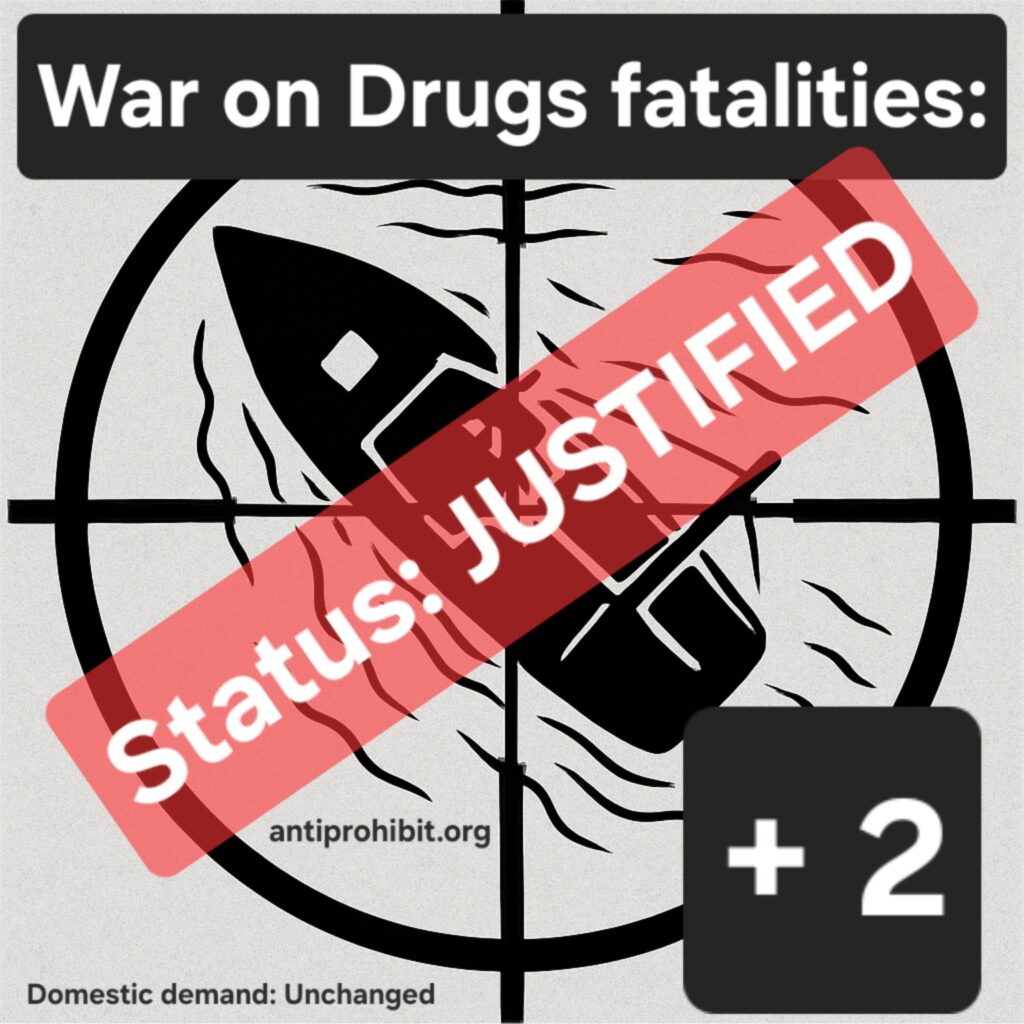
Recorded as an operational success rather than a policy failure.
The Deaths Were the Objective, Not the Mistake
Demand Was Always Domestic
Contrary to recent political rhetoric suggesting that America is under biochemical siege, the core motivator isn’t foreign aggression but domestic appetite. Americans consume illicit substances at a level unmatched by most of the world.
Consider the verified numbers:
In 2022, the CDC reported 107,941 overdose deaths, and approximately 75–80% involved opioids.¹
In 2023, overdose deaths again exceeded 100,000.²
This is devastating. It is human loss on the scale of two Vietnam Wars every decade.
But this is not “millions dead,” as political figures such as Pete Hegseth have claimed on national broadcasts. The verified total overdose deaths over all recorded years (since national recording began) are closer to 600,000–700,000 total — not millions.
Let’s make one thing perfectly clear: even one overdose is too many, but when federal leaders inflate these statistics, they are not conveying truth; they are justifying escalation.
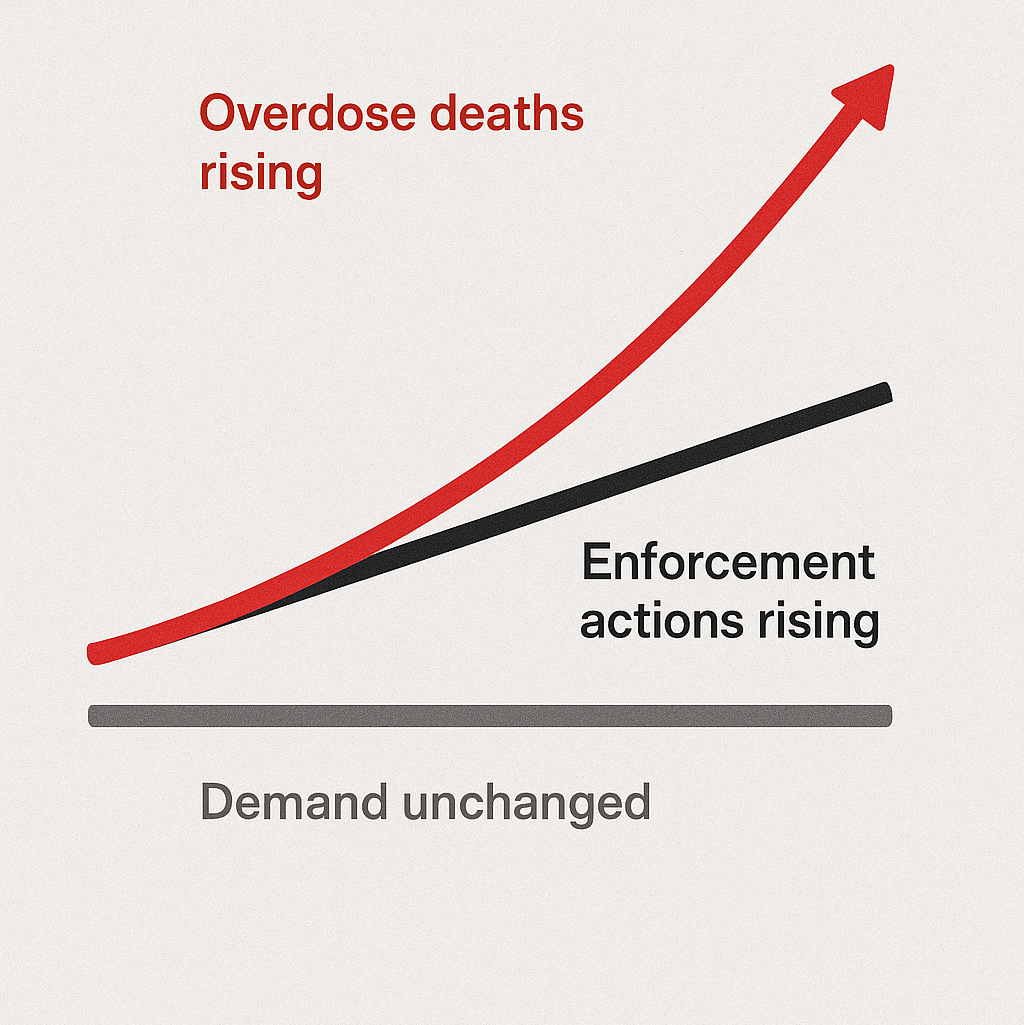
Enforcement doesn’t eliminate demand—it shifts the casualties.
A System That Protects Itself instead of Citizens
Prohibition Created the Drug Empire. When drugs are illegal yet desired, three outcomes are guaranteed:
- Prices rise
- Profits soar
- Criminality becomes the supply chain
That’s exactly what we’ve witnessed over the past 100 years.
Federal audits have repeatedly shown that interdiction outcomes are logged and justified internally, without demonstrable reductions in drug availability or demand.
A Trillion Dollar War
Federal spending on drug enforcement has exceeded $1 trillion since 1971.³ This includes:
- DEA Opererational Budgets
- Federal Incarceration
- Border Interdiction
- Foreign Interdiction
- Domestic Policing Grants
- Narcotics Task Forces
- Supply Disruption Initiatives
Yet after this trillion-dollar expenditure, and the immense financial burden of drug prohibition, drugs are easier to obtain, cheaper, and purer than ever recorded.⁴
That is not failure
It’s a functioning economic engine. The same government that put a man on the moon absolutely could do a better job of keeping drugs off of our streets, but they aren’t. Why?
Its a feature, not a bug.
If heroin, fentanyl, and cocaine vanished tomorrow, the budgets of dozens of agencies, private contractors, prisons, research institutions, surveillance programs, legislative councils, and political platforms would vanish along with them.
This war was never meant to end; indeed, it cannot even be won.
This war was meant to scare taxpayers into allowing our government to leech more revenue. So far, it has worked like a charm.
When there is a financial incentive to fail, success becomes unattainable.
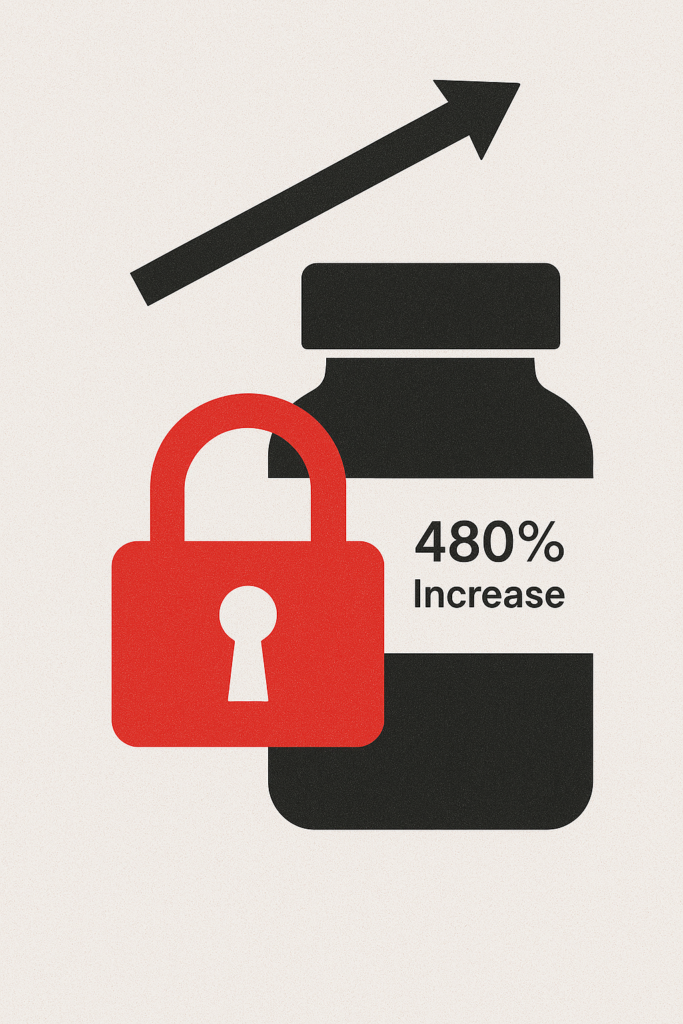
FACT: Since 1984, access to pure morphine has been restricted under enforcement protocols, pushing patients toward pharmaceutical substitutes costing upwards of 480% more. Meanwhile, opioid overdoses have increased by more than six-fold since that time.
“Narco-Terrorism” is Merely Political Branding
Labeling traffickers “terrorists” is not a moral classification — it is a strategy. When the term terrorist is invoked, the federal government gains:
- expanded military jurisdiction
- indefinite detention authority
- surveillance exceptions
- Congressional blank-check spending increases
- inter-agency consolidation
Narco-terrorism becomes the new “War on Communism.”
Or the post-9/11 “War on Islamic Extremism.” Or the “War on COVID non-compliance.” The subject changes. The emergency label remains. This exact rhetoric was used to justify the recent strike. But what was actually struck? Not an ideology, a foreign nation, or an invading force.
The U.S. struck what was fundamentally a logistics node – a small cog in the machine that they built – supplying substances to our own population. That is not a war against an enemy nation. That is a war against demand. You cannot bomb demand. You can only bomb supply, which creates scarcity. Ironically, this only increases demand, which raises prices. Cartels couldn’t ask for more.
Violence Was Guaranteed by Policy Design
Where prohibition exists, violence exists. Alcohol prohibition produced:
- Bootleg Networks
- Organized Crime Syndicates (gangs)
- Violent Distribution Routes
The federal repeal of alcohol prohibition dissolved these instantly. No military intervention needed. The same would occur with narcotics. But instead of dissolving the violence, the government elevated it. Since then-president Richard Nixon declared his “War on Drugs” in an effort to distract from certain unscrupulous practices his administration was engaged in, we have seen an increase in the availability and potency of narcotics. Additionally, we have seen:
- Weapons flowing to interdiction teams
- Militarized police units multiply
- The DEA expand its power and influence internationally
- Prison populations balloon
- Encrypted distribution evolve
In 1980, approximately 40,000 people were incarcerated for drug offenses.⁵ Today, it is over 450,000.⁶
Supply didn’t vanish. Users didn’t vanish. But a workforce for the prison economy materialized.
The War on Drugs Requires Perpetual Failure
If the war ever succeeded, tens of billions of federal dollars would evaporate annually. Consider just three industries (Click the arrow to see the dropdowns):
1. Private Prison Industry
Their valuation depends on occupancy rates.
Drug offenders are the most reliable supply chain.
2. Federal and state law enforcement budgets
Drug-enforcement funding increases most consistently during perceived crises. Currently, the taxpayer provides billions of dollars annually to combat the so-called “Opioid Epidemic.”
3. Pharmaceutical Competition
When regulation eliminates access, pharma profits surge. Nothing undermines patented pain-market revenue more effectively than unrestricted sale of substances like morphine in botanical form.
When restrictions tighten further, demand shifts into black markets. Both markets operate simultaneously. That dual-track economy is intentional.
A Responsible Policy Exists — But Requires Courage
Ending prohibition does not mean endorsing addiction. It means eliminating the criminal violence that exists solely because prohibition exists. What healthy drug policy looks like:
- Legal production
- Not street-manufactured fentanyl
- Not improvised precursors
- Standardized purity
- No fentanyl contamination
- No analog guesswork
- Clinical-grade dosing
- Not diluted “powder math”
- Treatment first
- Not incarceration first
- Education, not propaganda
Other Western nations that have implemented these systems:
- Portugal
- Switzerland
- Uruguay
- Czech Republic
- Norway
All have seen and documented reductions in:
- overdose death rates
- drug-related hospitalizations
- criminally-associated violence
- cross-border trafficking
- incarceration volume
And all of those changes came without militarized conflict. If the point is to save lives, we’ve been doing it wrong.
The Real Enemy Is Policy, Not Chemistry
Drugs are molecules.They cannot intend harm. They cannot invade a nation. They cannot cross a border unassisted. Any one of these would at least allow the concept of waging war against them.
Only policy decides whether a molecule:
- becomes a medicine
- becomes contraband
- becomes currency
- becomes cause for war
Morphine in a hospital is relief. Morphine in a field is contraband. Morphine on a battlefield is a Godsend. Morphine in a tincture was medicine until 1924. Morphine in a crop today is felony class II. Chemistry didn’t change. Policy did.
What needs to change?
America is not at war with foreign traffickers. America is at war with the consequences of prohibition. She is at war with her own citizens. The recent strike didn’t eliminate a threat — it reinforced the economic justification for continuing the war. It added two casualties to the 600,00 deaths (in America) that already existed thanks to prohibition. Until prohibition ends, the violence continues. Until regulation replaces black-market chaos, the death toll is guaranteed to rise. Until honesty replaces rhetoric, the escalation continues.
We cannot bomb a demand curve. We cannot incarcerate addiction out of existence. We cannot defeat an enemy that exists because of our policies.
If nothing changes, nothing changes.
We’re building a community that refuses to accept policy failure as inevitability.
Change starts when the excuses end.
SOURCES
¹ CDC National Center for Health Statistics, Drug Overdose Deaths in the United States, 2022, Data Brief 491.
² CDC National Center for Health Statistics, Provisional Overdose Data 2023.
³ Congressional Research Service (CRS), War on Drugs Fiscal History, Legislative Briefing Archive.
⁴ Cato Institute, “Four Decades and Counting: The Continued Failure of the War on Drugs.”
⁵ Bureau of Justice Statistics Historical Incarceration Table A-17.
⁶ Prison Policy Initiative, Mass Incarceration: The Whole Pie (2024 update).
